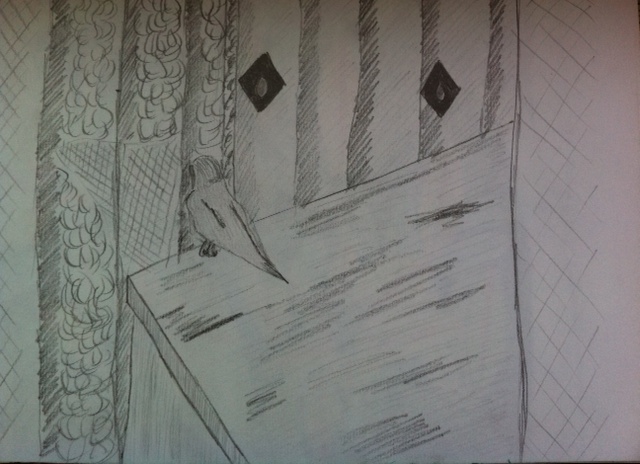
I love my garden so when my sweet peas looked and smelled wonderful I decided to sketch them and use this as my Stage 6.
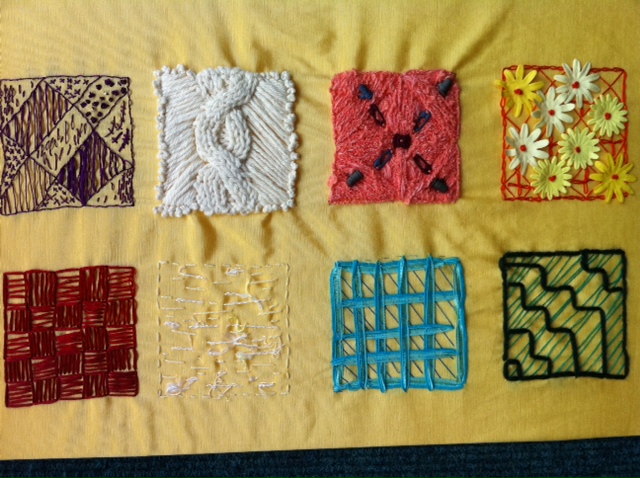
I hand stitched working on heavy cotton fabric, for the flowers I used different techniques to represent each one.Satin, Sedding, Blanket, French knots, Cross-stitch, Running & Couching were used, and for the Bamboo Cain's I used brown patterned material then used cross-stitch as couching and Herringbone.
Learning Log
* Can you begin to see the relationship between stitching and drawing?
Yes, I can see where the relationship is between stitching and drawing. I look at everything now in a different light. It's like lines and movement of media, dark and light.
* Were you able to choose stitches which expressed the marks and lines of you drawing?
The way I had sketched and put my marks made it a easy choice when it came to the stitches. I knew that each sweet pea was going to be different either with wool,thread or materials and the stitch would reflect that.
* Did you choose the right source material to work from?
I felt my source material was the correct choice, it brought to life my lovely sweet peas. The media did just what I expected it to do. (shine through like a ray of sunshine!).
* Do you think your sample works well irrespective of the drawing? Or is your sample merely a good interpretation of your drawing?
I think you could go with both, the sample has got feeling and texture, my nephew couldn't tell what is was but my niece could!. I think it has a good interpretation of my drawing as you can see where the inspiration is coming from.
* Which did you prefer - working with stitch to create textures or working with yarn to make textures? Which worked best for you and why?
I enjoyed both because they both gave great variation, having not worked like this before I didn't have a preference. I loved the couching with cross-stitch, also using the different material then stitching on top of them.
* Make some comments on individual techniques and sample pieces. Did you experiment enough? Did you feel inhibited in any way?
Couching was a new technique to me, so when I did my rose (Project 2 - Stage 3) I was thrilled at how it turned out. I thought the Satin stitch - green (again new to me) on project 2 exercise 2 had a very striking impact with wools and cotton threads showing real depth of colour,direction and shape.
I really enjoyed all of this project, it would have been better if I could have used my sewing machine. I feel I missed out a little not having the advantage of combining both hand stitch & machine together.
I did not feel inhibited because I worked with what I had, and my ideas were there before I started stitching.
* Do you prefer to work from a drawing or by playing with materials and yarns to create effects? Which method produced the most interesting work?
I prefer to work with a drawing because to me I like to get ideas down on paper also the thought process has been done. I then find it easy to visualise what materials and media I want to use.
* Are there other techniques you would like to try? Are there any samples you would like to do in a different way?
I didn't get the Cretan stitch done so this is one I will bringing in a some stage.
The sewing machine samples I would like to give a go. I was happy with the samples I had done, the only one I was disappointed with was Stage 5 the white and lemon sample. Another time I would change the colours.
* Is there anything you would like to change in your work?
I wouldn't change any of my work, but I would like to carry out more samples and experiments. I did feel I had spent loads more time than recommended but it was well worth it and I was pleased with the results.
REFLECTIVE COMMENTARY
So far so good, I've had an incredibly journey. Its been positive most of the time, Initially at the start I found it difficult with the sketching (having never been an 'artist'). I had a struggle with my imagination and it was a learning curve to let it take hold. I think in my mind I had to tell it that there is no 'right' & 'wrong' answers and this was not easy to do.
I have always cross-stitched or knitted and you always had a pattern or kit to work from, so it felt very strange to be able to have freedom of stitch. I have learnt to ignore the straight forward rules & regulations I was used to, and creativity is now happening.
Each exercise has taken me a lot longer to complete but I think that was due to me enjoying the work, it did worry me though, that I was not doing enough examples (this still does concern me!).
I feel I need to experiment more with the different textures in project 1 exercise four, I'm not sure which way I will go with this but I felt more could possibly be done.
I did become frustrated with my sewing machine, this is one area I will be working on when I get it working correct. I felt I had missed out on trying the different designs, also maybe combining hand stitch with the machine would have been nice to try..